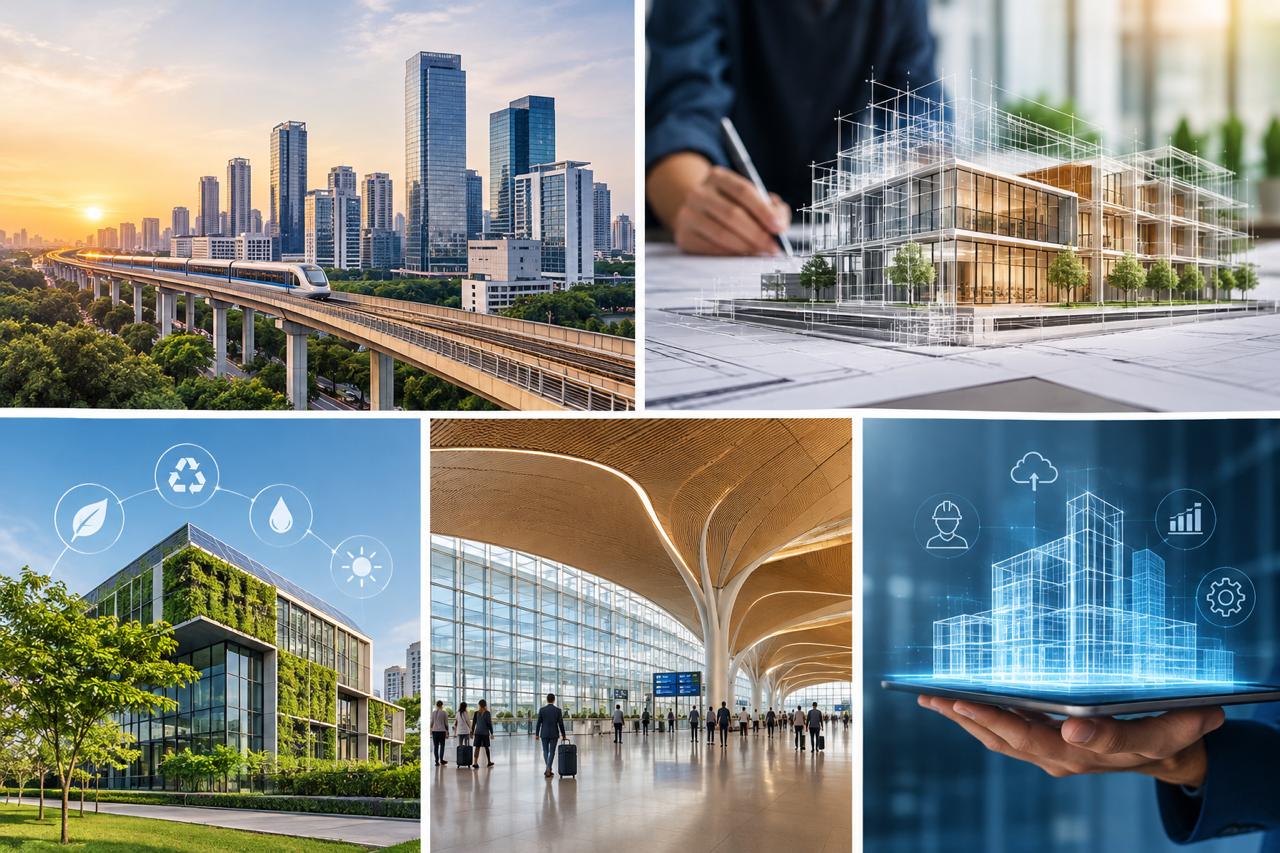
- Architecture
- Infrastructure
- Urban Planning
- Futuristic
Architecture as a base for development
Infrastructure is the backbone of economic development. Hospitals, Offices, residential units, airports, logistics hubs, institutions, utilities, and industries, etc. all depend on thoughtful planning and design.
Architecture weaves these together by translating requirements into spaces that people, technology and operations can use efficiently. A successful infrastructure project therefore begins long before construction. It starts with understanding the site’s potential, the surrounding context, operational requirements, environmental conditions, movement patterns and future growth.
This is where architecture and infrastructure planning intersect. The objective is not simply to construct a building. It is to create an integrated system that performs effectively over its entire lifecycle.
Integration of various layers of the ecosystem
As the requirements and expectations from any project are more complex than ever, Architectural design must work alongside structural engineering, MEP (Mechanical, Electrical, and Plumbing) services, fire and life safety, transportation planning, sustainability, technology and project execution.
This integrated approach changes the way projects are conceived. Instead of treating each discipline as a separate component, architects and consultants must understand how every decision affects the overall performance of the development.
Forward Looking
One of the biggest challenges facing infrastructure today is uncertainty. Buildings and infrastructure are expected to remain functional for decades, while technology, business models, environmental conditions and user expectations can change dramatically within a much shorter period.
Future-ready architecture therefore needs to be dynamic and requires flexibility. Spaces need to be adaptable. Services need to accommodate technological upgrades. Infrastructure networks need sufficient capacity for future expansion. Materials and systems must be selected with durability, maintenance and lifecycle performance in mind.
This is particularly important in sectors such as data centres, healthcare, transportation, education and institutional development, where operational continuity and scalability are critical.
True Sustainability
Sustainability is no longer simply about adding energy-efficient equipment or incorporating green elements into a building. True sustainable infrastructure considers the entire lifecycle of a development.
This includes site planning, material selection, energy consumption, water management, waste reduction, mobility, construction practices, maintenance and eventual adaptation or redevelopment. Good architecture can reduce the environmental impact by making better use of natural light and ventilation, improving building orientation, reducing unnecessary material consumption and creating efficient spatial and operational systems.
Focus on user experience
Small projects or Large-scale infrastructure is ultimately built for utility for people. Whether it is an airport, corporate campus, educational institution, healthcare facility, commercial development or public environment, the quality of architecture has a direct influence on how people experience the place.
Wayfinding, accessibility, comfort, daylight, acoustics, inclusivity, movement and spatial clarity all contribute to the success of an environment. Infrastructure should therefore not feel purely functional or mechanical. It should be understandable, welcoming and responsive to the people who use it.
Technology
Digital technologies are transforming infrastructure design. Building Information Modelling (BIM), data-driven planning, digital coordination, simulation and advanced visualization allow design teams to understand projects with greater precision before project execution begins.
For complex infrastructure, this means identifying potential clashes, optimizing systems, improving coordination and making better-informed decisions at earlier stages. Technology is not replacing architectural thinking; it is strengthening it. The architect’s role is increasingly becoming that of an integrator —bringing together people, information, technology and multiple disciplines to create a coherent and high-performing development.
Multidisciplinary
The infrastructure projects of the future will demand closer collaboration between architects, planners, engineers, consultants, developers, technology specialists and construction teams. No single discipline can independently solve the challenges associated with rapid urbanization, climate resilience, resource efficiency, technological change and growing infrastructure demand.
The most successful projects will be those where these disciplines work together from the earliest stages. Architecture has an important role in creating that common vision.
Beyond Structures
The future of architecture is not simply about taller structures, larger campuses or more sophisticated façades. It is about creating infrastructure that works better.
It is about connecting buildings with their environment, integrating technology with human needs, balancing growth with sustainability and designing dynamic ecosystems.
Architecture is therefore becoming a strategic component of infrastructure development—not merely shaping how places look, but influencing how they function, perform and adapt.
Imagination Infratech
At Imagination Infratech Pvt. Ltd., we believe the most meaningful architecture goes beyond the physical structure. It is about understanding the larger system, anticipating future needs and transforming complex requirements into integrated, efficient and enduring environments.
Because the infrastructure of tomorrow will not be defined only by what we build. It will be defined by how intelligently we design it.